

Being pulled from the classroom and put on administrative leave was horrific.
It took months to realize what it truly did to me, and I’m still having those realizations in quite inconvenient and devastating moments.
We went back to work last week, with staff reporting Monday - Wednesday for three days without students. I went into the building the previous Thursday and Friday to get my classroom together, primarily because I need many days in my room to put my things back in their place, decide I want a new start and change the entire configuration of the room, and then finally realize I had it the way I started for a reason and move it all back, sans a change or two.
But the quieter reason was I knew I was vulnerable to a breakdown as I recreated the environment that was unjustly stripped from me, kept from me, and then returned with no resolution. When the district finally brought me back to work, seven weeks after I had been pulled and five weeks after I was deemed innocent, I was informed they planned on moving me from my school for the following school year.
This was first proposed to me immediately after my investigation interview concluded, while I was still sitting at the table for eight but set for four. I was told I’d likely be given a list of schools with openings I could choose from, that this happens with members who go through extremely harmful situations with their building administration.
But my extremely harmful situation hadn’t been with my building administration. It had been with my union.
Nonetheless, I agreed. I’d like to see the openings available and possibly take a fresh start. …But that opportunity never came. Our internal transfer process started while I was on leave, and members around the district interviewed and accepted positions while I laid on my couch staring at the ceiling, closing my eyes and sighing with deep annoyance every time the record needed to be flipped. It was in these moments I understood the evolution of and excitement around the Compact Disc.
The day before our district’s “job fair” (which is the last round of job postings during our internal hiring/transfer process) I finally heard from the district via my union rep. My only choices for next year would be what was left at job fair, internally known as the bottom of the barrel, and I had to decide that moment, on the phone, what I wanted to do: commit to taking a job off the board at job fair, or stay in the position I was in. They needed to know right then because if I committed to attending job fair, that meant I was vacating my current position, and it would be at job fair for other members to take.
So I chose to stay with the devil I knew instead of a devil I didn’t.
After job fair concluded I was told they’d be moving me anyway: involuntarily transferred, and they could (and likely would) wait until August to tell me where.
I asked how they could do that to me? We have contract language around involuntary transfers, I am not in a high needs position, but rather a dime-a-dozen secondary English teacher, and I did nothing wrong. I said if they were going to do that to me, we would file a grievance immediately, right?
I was reminded that even though yes, it would qualify for a grievance and we could file, the reality is I would have to comply with the directive while the grievance process played out, and would I really rather start at a new school and then move back to my current school after the school year had started, provided I eventually win the grievance? Which process was actually more disruptive?
I was told to stop fighting. I had been on paid vacation, after all.
The day of Monday, February 23, 2026 moved so fast I could barely keep up, which is really saying something. My feet move almost as fast as my brain, so when my environment shifts become waves impossible for me to surf, I am left beside myself.
The student-led ICE protest at my school was Friday, February 20th.
I did not hold the library door open, like the news reported.
I did not lead droves of students out the front door, like the news reported.
I did not lead the student ICE protest, like the news reported.
I did not block the exit doors of the building, like other staff did.
I did not give the protesting students the middle finger, like other staff did.
I did not lock scared students out of the building for the rest of the day, like my bosses did.
I did not split the groups of students, like other staff did.
I did not tell students they could protest for weeks and then change my mind the morning of, like my bosses did.
I did not buy the students the poster board and markers for their protest signs, like my bosses did.
I did not record students on my personal cell phone, like other staff did.
I did not keep student cell phones and backpacks locked in the school over the weekend, like my bosses did.
I didn’t even know that all happened until my investigation interview.
The end to the Friday of the protest was uncomfortable for everyone, but I don’t remember it very well because I went straight to the headquarters of my state union, Ohio Education Association, for a meeting with our state union president, about something completely different. Our caucus had been in touch with the Massachusetts Teachers Association leadership and we wanted to start the work on passing a Millionaire’s Tax to fund our public schools, libraries, and transportation, and I wanted to see if he was going to be supportive or if he was going to fight us on it. I needed to know the organizing effort that was ahead of us on the statewide front.
In that meeting I told him we could not wait for a solution to come to us with school funding. The state of our schools is so desperate and deplorable, we have to act now, we can’t afford for our jobs to get worse. He asked me to tell him about my job, about my school. It was a genuine question, I thought and still do think he wanted to hear about it, and I remember staring down at the table and just… not being able to. Where would I even start? And after the day I had? And in the middle of the campaign I was in?
My principal would send me three emails over the weekend, which I wouldn’t see until Monday morning. The first one would be sent on Saturday to me and one other person, saying we needed to have a meeting with him first thing Monday morning. He would reply “Disregard.” shortly thereafter.
The third email would be sent just to me, saying I had a meeting Tuesday morning with him and it was disciplinary in nature, and I would be needing a union rep. I’d read this when I got to work at 7:15, and walk myself straight into his office and say “Are you kidding me? Are you so for real right now?” and narrow my eyes and throw my hands up and say “What makes you think I actually have time for this?”
The relationship between my principal and I perplexed most, especially other union reps, but we understood each other. It took two years for him to realize I wasn’t going to back down when it came to worker rights, and when I fight, I win. When I organized my building to fight for more staffing, we both saw what was possible when we fight the bigger fights together.
But his bosses would pressure him to come down on me and retaliate for organizing, and everyone has a game to play. He would throw me under the bus every time, but he would give me a heads up about it. Twice I looked him dead in the eyes and asked “Are you doing this because you truly feel you have no other choice?” and we would dance the dance accordingly, me gaining another feather in my cap with every win.
He was very much in favor of our union campaign. The obvious reason to this is because he wanted me out of his hair1, but I think he really did believe in me, and he really helped me at an important part of my career.
Years ago I was struggling with not knowing what to do, I told him I was having a hard time managing graduate school, the union work, and teaching, and I started to cry in his office, which I found deeply humiliating in the moment because I had sat down to talk about simple English Department necessities, and the conversation had evolved.
“Kelsey, you have a gift. Do you know that? Not many people have what’s inside of you, and most of the people that do, don’t have the words the way that you do, they can’t move people like you can. Go, girl. If there is something standing in your way, you need to figure out what it is, and move it.”
And still, after that, he would create situations in our building that would cause me to hate him.
But people are complicated, myself included, and the ways in which we are intertwined in the struggle for liberation is intricate, maddening, and real.
I’d never doubt a boss telling me I needed a union rep, but when he put that in writing, I really fucking believed it.
And he tried to keep that union rep from me. That Monday, February 22, 2026 started with that email.
Then I called my union rep and told him I needed him.
He wasn’t available until later that week, so I emailed that back to my principal.
My principal said it didn’t matter, we’d be having the meeting anyway.
A little bit later, during my lunch, I’d see my principal in the hallway, as we were both on our way to my classroom from opposite ends of the hallway, and I’d throw my hands up at him for the second time that day and holler “You can’t do that! You KNOW you can’t do that, what are you thinking?! You can’t deny me my union rep.”
And he’d tell me listen, in lieu of a meeting, send me a statement.
A statement about WHAT?! Because it still hadn’t been made clear to me what exactly I was “in trouble” for.
“About Friday.”
What about Friday?!
About the ICE protest.
“I didn’t DO ANYTHING, there’s nothing to write a statement about. You want me to write a statement about where I was and what I saw between the hours of noon and 2:30?”
Yep. And send it to him before the end of the day.
I told him send me that in writing! and he did.
So I wrote my statement.
And as my union rep was looking over the statement, at 2:30pm, my principal walked through the door and handed me the letter.
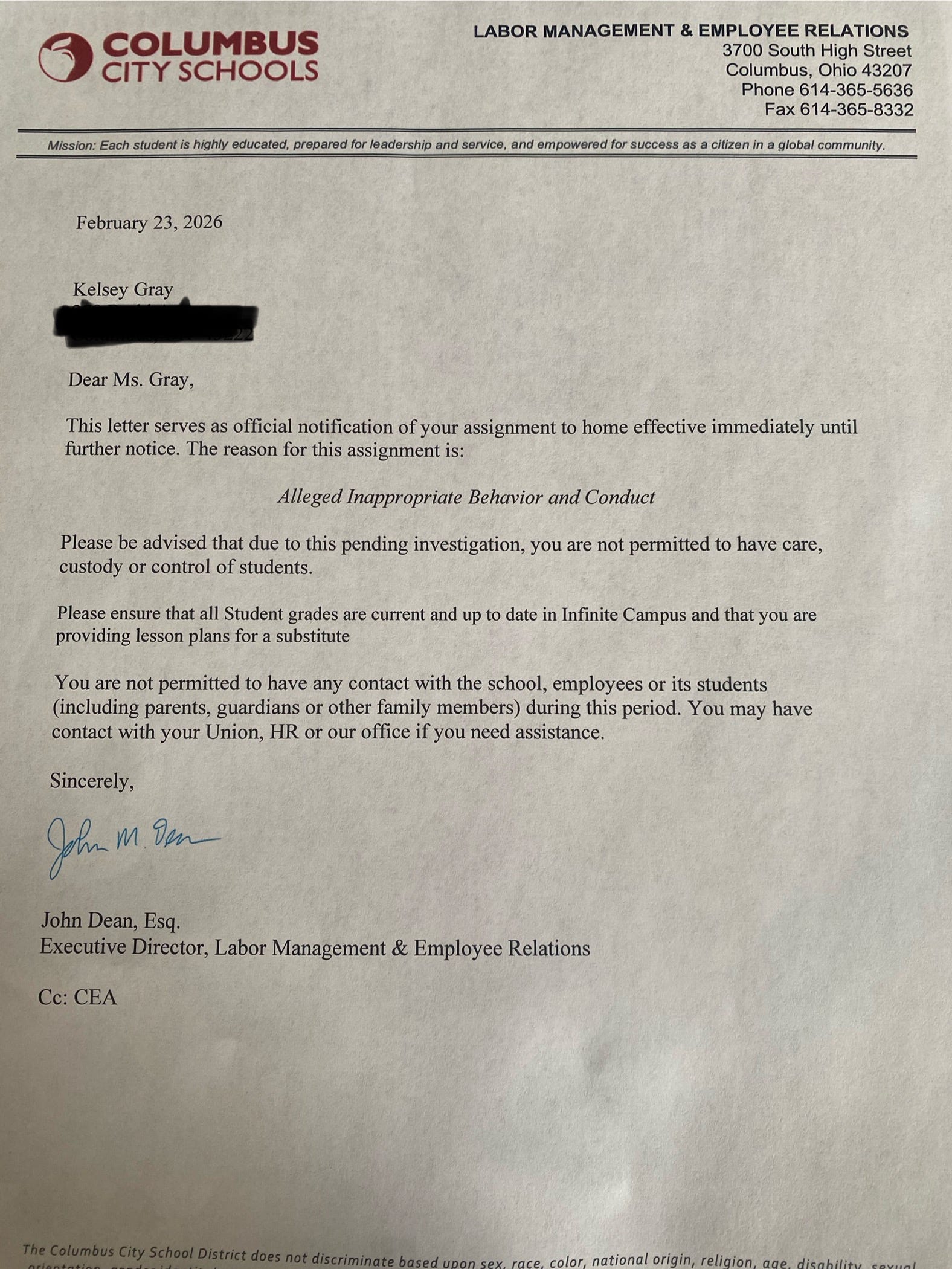
My mouth dropped open and I looked up at him, that I remember clearly, and I think I asked him if he was serious. Maybe something like “Are you fucking kidding me?”, or I might not have said anything at all. I can’t remember if words actually came out.
What I do remember is erupting in sobs as soon as he walked out. I would not cry about this situation until months after February 23rd. I would not properly start to grieve until July. I would not properly start to heal until writing this series.
My hands shook as I took a picture of the letter and sent it to my union rep, I also sent it to my two work friends. Two things happened:
My two friends walked in and I told them to get out, I told them I couldn’t talk about it, I told them to leave me alone, and I told them I was serious.
My union rep called me, and I can’t remember the conversation. I think he told me about sub plans, I think he told me it was okay, I think he told me it happens to a lot of people, I remember a comforting tone with no comfort, without feeling at all like my situation was understood — this is how I believe most people feel, I don’t think it’s really possible for anyone to feel any other kind of way in that moment.
And then I drove to the Columbus Gifted Academy, because I had booked a visit there to speak with their union members after their staff meeting.
I could not stop crying. While accelerating onto I-70 I started talking out loud to myself in my car.
“You have to get it together. Shove it down, forget about this entire experience right now, you will not get another chance with these members. Get it together. Shove it down. Focus.”
And I did. I rolled down my windows and the frigid February air cooled my puffy eyes, and I took slow, deep breaths. I walked into the building and had a great visit with incredible educators. My campaign pitch came smoothly, it did every time, it’s not hard for me to speak on what I believe and know is possible. I spoke with members individually for a long time after the meeting ended.
I love speaking with members. I am in my element when I am connecting with workers, the rest of my world stops. I also didn’t want the visit to end, because the end would bring my new reality. I wanted to stay in that moment, in that conversation, with those teachers, in that library, forever.
But the world doesn’t stop for anything.
I was told I didn’t need a lawyer, and when an outside friend forced me to come face to face with my circumstances and realize I needed one, I lost confidence in my union. I have not regained that confidence.
I didn’t know what to do. I almost called my state union president for advice, but as my thumb hovered over his name, I made a game time decision and called my state union’s immediate past president, SD.
SD and I are vastly different, but he’s delivered mentoring advice when I needed it before, and I knew he would tell me what I needed to know. I couldn’t call my union office because they were hostile to me, and I truly did not think they had my best interest in mind. I couldn’t call my state union president because that would probably be weird for him (and me). SD didn’t have a pony in this race, and he had the institutional knowledge, answers, and context that I needed to guide me.
He’s currently running for a political statehouse position, and at the time his campaign announcement had been somewhat recent, so when he answered with “Hi Kelsey!” I asked him how his campaign was going, and told him I was running one of my own.
I told him something had happened and I wasn’t sure of my rights as a union member, in my local union or my state union, so could he tell me? And when he said yes, what’s up? The words caught in my throat and as I clenched my jaw I felt the tears build up and I knew when I opened my mouth, they might fall.
“I’ve been pulled from my classroom and put on administrative leave” tumbled from my lips in heaves and choppy inhales, and in that moment he said what no one else had.
“When a member is put on administrative leave it is just horrible. It’s so hard, I’m so sorry. It just really is so difficult.”
Those words were the hug I needed. I stood at my kitchen island and nodded, and with my eyes closed, “Yeah, yeah it really is”.
And he answered my questions. He told me my rights in my local union, my rights in my state union, we went over the role of specific union staff members, and what their responsibilities are, and if I, as a member, felt that I wasn’t adequately represented in my case, what do I do?
This wasn’t the first time I’d called on SD. I had called him in the spring of 2025 for advice, how he was able to sustain himself in this work. I asked him quite personal questions on how to balance passion, work, drive, and various elements of life, and he gave me honest answers. That remains one of the smartest phone calls I have ever made.
Chris and I observed the ballot count for the election simply because we could. Our union’s Constitution and Bylaws say officers have the right to observe, and I thought that was there for a reason, so we might as well take advantage of it. I, obviously, was free to attend without needing to use paid time off, but the same was not the truth for Chris. He used a day to sit with me as we watched the ballots amount to our loss.
We knew we’d lose. We had hope for a win, because we are capable of the job, and that is how you have to get through a campaign. But we’re not stupid. Most union reform efforts take two election cycles.
It rained the whole day, and as we walked from our street-parked cars to the union office, I told him I was glad we had campaigned the way that we had: with class, with dignity. With our vision and platform at the forefront, always, perhaps to a fault, as he pointed out. I told him I was glad we didn’t go low on the Facebook Coalition page, and he said if a Facebook page is really how members want to receive their union news and communicate, our union wasn’t ready for our leadership in the first place.
Chris is talented at many things, and one of those things is slapping our reality in my face when I am fixated on What Could Be. It is one of the countless dynamics that make us a strong team.
We are friends, but friendship is not what keeps us working together in labor organizing. We have had to learn what frustrates us about the other, and we have chosen to work through those frustrations instead of letting it build animosity between us. We have chosen to embrace our differences because they are what force us to listen to each other, to reach complete understanding, because it allows us to see our Whole Reality as educators and union members and leaders, and ultimately, it informs us on how to move forward.
And that is hard. And it is exhausting. But it is worth it, and I believe it is how a powerful and effective leadership team operates.
During the candidate debate nights, the incumbent vice president2 of our local union spoke well about how he has been vice president to three different presidents and effectively carried out different leadership visions. Chris had said he thought he had the harder job in the campaign, and I didn’t fully understand what that had meant until watching them that first debate.
But that is one of the powers of a slate: if members believed in one of us, they would have to trust us that we needed to be elected as a team to deliver the platform.
Our vote tallying system is archaic: our state union staff member, who fed the ballots into the machine and ran the software system, reminded the room of that several times during the course of the 7 or 8 hours it took to deliver the count. We are the only local union in the entire state that still votes in this manner.
It was so boring.
My only real memory of those hours is standing at a window, watching the rain fall, and wondering if anyone else in that room besides Chris was aware that I was spending my days at home instead of in my classroom.
I moved through those days in a complete haze. I did not know what to do with myself, so I did nothing. I slipped into a dark depression, having to force basic hygiene routines, mindlessly scrolling social media. I was laying in bed when I scrolled past this post on the union Facebook Coalition page:
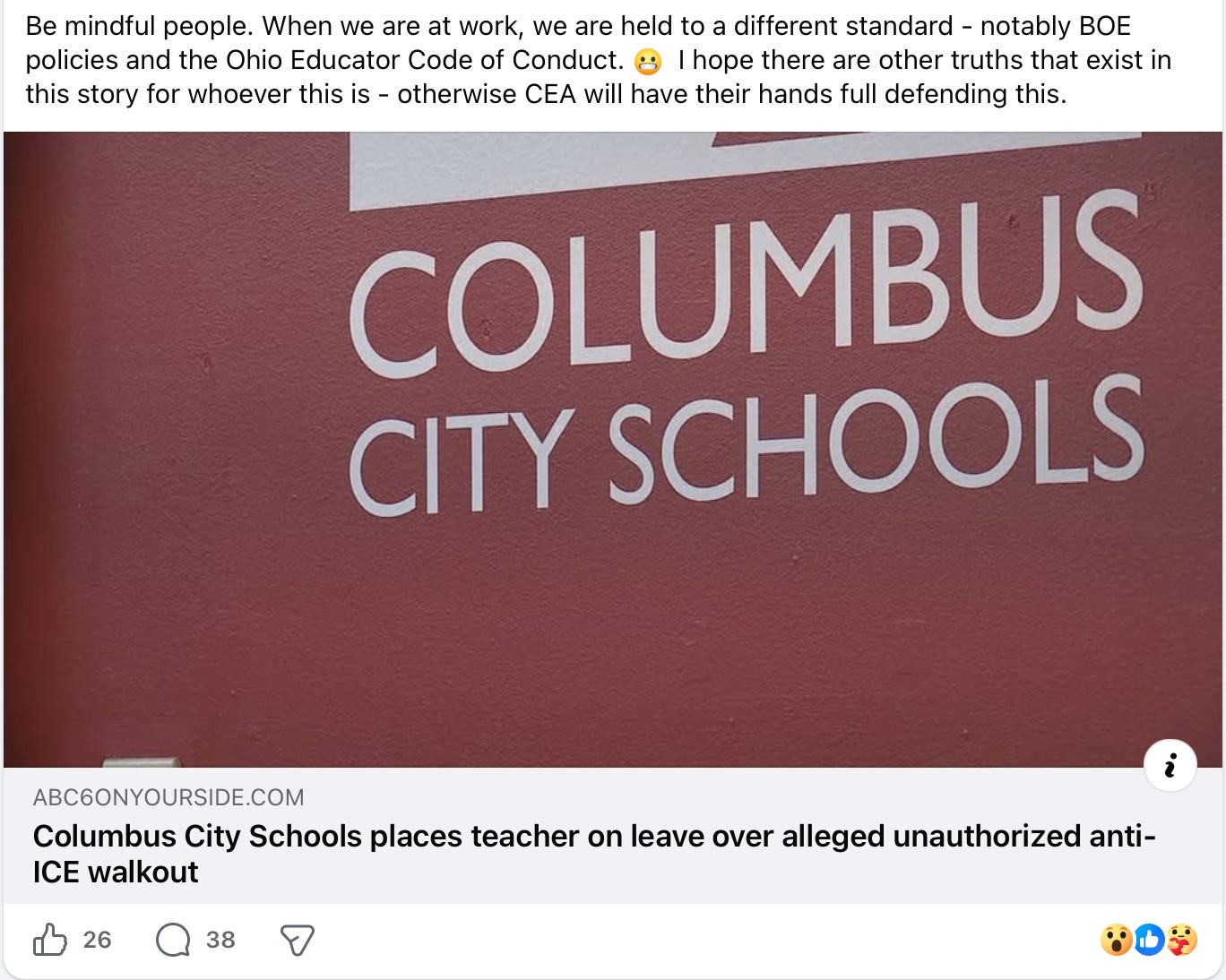
Most news articles had the name of my school in the headline.
Most people knew it was me.
The person who posted this knew it was me. He had been very vocal about supporting the incumbents. You can imagine what the comment section looked like, from a page where most people found my existence and my campaign repulsive.
I rolled over and stared at the wall. That is how I spent most of my days until my investigation interview.
I first began to heal from teaching when I had been out of the classroom for about a week, and I felt it in my muscles, in my bones. It felt like my joints had been made of rubber band balls, bound tightly, at capacity. One by one, they started to snap. I started to be able to move better, to move with ease.
Trauma manifests itself in the body, and our public schools are traumatic environments. Educators hate to admit that because it eclipses the beauty and joy in public schools, but it’s the truth. School shouldn’t be like that for children, and work shouldn’t be like that for workers.
After my innocence was proven, spring weather came to Central Ohio. With a healing body, proven innocence, and warmer weather, I returned to running, and I realized the ways teaching and union work has taken my life from me.
I’ve been a long distance runner for most of my adult life, spurred into the sport by heartbreak in my early 20s. It has always played significant roles in the chapters of my life, taken me up and over mountains, along ridges from southern Colorado to northern California, from the painted desert to surfing in Ventura.
But I have to be at work at 7:15 in the morning, which means I have to leave my house at 6:50, so my alarm goes off at 5:30 because a calm hour with coffee is a mandated start for me. I prefer to run in the morning because of the way it helps my brain, because of the way it improves my days, it is a very serious quality of life factor for me.
For years I let teaching take that from me because I chalked it up to privilege. I moved my running time to after work and learned how to hate the sport and how to hate myself with the sport. I am exhausted after work. The sun is set to broil from 3-5pm well into October in the concrete jungle of my running routes, my brain is begging to turn off instead of wake up, my muscles are tired from taking in the stimulation and harsh environment of school for 8 hours.
I love to bake. I also love to cook, but I really love to bake. There is no time for baking while teaching, there is no time to explore recipes when you take a second unpaid job as a union member, and a third unpaid job as a labor organizer.
I love to write. There is no time to write when there is no time to heal.
So when teaching was taken from me, I got all of that back. I went out for 10 and 15 mile runs on back to back days. My mileage went from 10 miles a week to over 40. I stretched, I hydrated, I rested, I nourished to avoid injury because I had the time to do so.
A few days after I was placed on leave, I told my union rep I thought we needed to organize around this because our local union had taken a public stance against ICE, and our union president had been at other student ICE protests, so it made sense to defend a member who was (wrongfully!) going down for an allegation of supporting one.
But I was told the public wouldn’t be in support of me. The public would think I was complaining about being on paid vacation, I should think of the optics.
Teacher unions play into these narratives against us so often that I honestly think we, as in the union institutions, are to blame for the narratives themselves.
“I’m not on paid vacation! I want to be back at work! I teach TWO tested subjects, my students need me!” Alas, to no avail.
So I healed from teaching. I started to get the wholeness of my life back, and I started to realize I didn’t think I had friends. With every day that I was kept from work, I expected to hear a plan for action from our election slate, from people I had organized with for years, that I had categorized as friends, but I never did.
I had spent years bringing people together, building relationships, articulating a shared vision for a better profession, a better public school system, and I got lost in the middle of the Venn Diagram. I had hosted organizer trainings in my living room, made meals and mugs mistaking the foundation of a movement for friendship.
And then I paid the price when the cost was me.
I was a failure. I had failed in my union campaign, I had failed at being “on the inside” of the union, I had failed at protecting myself, I had failed at having friends, I had failed at responding to my family’s group chat for months, I had failed in training organizers, I had found a way to fail graduate school despite having a 4.0.
I had failed at being worth fighting for.
That was so painful that I wouldn’t be able to fully acknowledge it, to really look at that part of my life, until the later part of summer. I knew I would have to deal with it that pain eventually, but I had to get through the end of the school year. And then I had to go to Denver for a wedding. And then I had to be on a panel at Labor Notes. And then I had to go back to Denver for national union work.
So I shoved it down and told it to wait, but it couldn’t all wait. I addressed the part I could compartmentalize, the part I knew how to do, the part I knew had to be addressed for the movement to continue: The organizing part.
If I was going to be teaching people to organize, I could not let it be acceptable for retaliation to fall by the wayside. Because if we were going to reform our unions, I would not be the only one to be retaliated against, and if members don’t learn how to stick up for each other, how to know when and how to act, we will lose and we will lose people. And we can’t afford to lose people.
One evening into the late spring, after I went back to the classroom and had been attending end-of-the-year union meetings, Z and I sat on our front porch sipping tea, watching dusk turn to night and quietly chatting about our days. I shared that I was struggling being in union meetings, watching silence perpetuate amongst members as people lose their jobs, as more schools close, and as my reality goes unspoken, unacknowledged, left to drift into the book of dark union secrets, undoubtedly a reason behind a barreling resignation.
I told him I was starting to feel the pain of the inaction of others, what I thought was work rooted in justice. I was wondering if a wagon had been hitched to my name, was it really all just me doing this work, was I really doing any work at all, if this is what my reality was?
Was I even worth fighting for in the first place? What made me think I was anything special, that I deserved to be protected, that I deserved to be fought for? What if I wasn’t even a good teacher?
Z doesn’t comment on my union work stories unless he can speak with certainty. He likes to know all angles, every piece of relevant information, before forming an opinion or expressing an emotion. It is equally frustrating and valuable.
My existential questioning led a long pause filled with the sounds of our neighborhood: barking dogs, the hum of I70 traffic, distant music, a police chopper, crickets, the wail of an ambulance, soft rustling of the plants in the breeze.
“If what happened to you had happened to anyone else, you would have ripped this city apart.”
I knew what he meant, but I asked him anyway.
“You would have figured it out. Nothing would have stopped you.”
—
I am set up to have a successful school year in my building. We have an entirely new team of administrators, my old principal left the district and took others with him. I have never met a boss I’ve liked but I’m open to the chance that they do exist, and so far, the odds are in the favor.
On Tuesday of the first week, I was caught off-guard by a trigger from one of our new administrators. They were using data from the 10th grade English OST scores this past spring and highlighting that the scores are low, kids weren’t confident in the writing portion of the state standardized test.
“Maybe that’s because their teacher was taken from them for 7 weeks before the test.”
There was no way I could’ve stopped myself from saying it, and not many people heard it. But I was cut deeply, and I didn’t see it coming.
I returned to my room and was visited by an unexpected colleague. A colleague that also went down for administration decisions. A colleague that also might have felt a certain way about that data being used.
Or not. It could’ve been a random conversation, a pop-in out of convenience, perhaps they were strolling through the hallway and just saw my door was open. We talked briefly about how to set boundaries with work, I sought their advice on how to keep teaching when you’ve taken a fall that hard for the bosses. It helped. But it also broke me.
I spent the next two hours in my room with my door shut and locked, sobbing on and off. At one point I was on my knees, crying so hard there was no sound coming out (thank god! those walls are so thin). I had never grieved in my classroom, I was too focused on getting through my conditions when I returned that I couldn’t confront my sadness. But I did on Tuesday, and I continued to cry. I cried my entire drive home. I cried when Mackensie called me, and I cried myself to sleep.
And Wednesday was a little bit better.
People ask me if I think there was collusion between my employer and my union, and my answer is yes. I will never be able to prove it, and I’m not really interested in proving it, I am interested in having a democratic and transparent union to improve my job. But my answer is still yes.
Chris once told me, and I think of it often, “Do not attribute to malice what can be explained by incompetence”. But my answer to that is, which is worse? To me, it’s incompetence. I’d rather things be done the dirty way, with “the politics”, aimed at taking me down, than believe the people above me are truly just so fucking stupid that they don’t realize the reality of workers, of students, of our conditions.
Right? Or is it worse that people would be so low, so vindictive, so scared, so hell-bent on making me quit, frothing at the mouth to keep their power?
I thought about that a lot when I was on leave. Our union leadership was not shy in telling us, all year, there were a record number of people being put on leave and investigated. I wanted to believe my experience was unusual. I felt my union didn’t care about me, I had no idea if they were sticking up for me, I was never given updates about what was happening with my situation unless I reached out, no one even checked in on me.
After speaking with many members who have been and are on leave, this is the norm. Many, many people feel this way, the experience is not unique to me. People feel alone, depression comes, anxiety stays with you every single moment.
And that is not okay.
But I’ve also found that people are put back to work after their investigations are done. They aren’t kept from the classroom for five more weeks with no communication.
There is also the famous quote that comes from the Teamsters reform, which is what I will close this post, and this series, with:
Aim for the boss and you’ll hit the union.
completely proverbial, as he is bald
I want to be perfectly clear: The vice president of our local union has always been kind, professional, and helpful. I greatly respect the person he is, the work that he does, and the ways in which he continues to help me with union matters of all sorts.