

chapter one
It’s impossible to continue without addressing my history with organizing labor. I will be brief.
I moved to Columbus from Denver in summer 2021. In Denver, I worked for billionaire Kimbal Musk (yes, brother of Elon) first at a restaurant called The Kitchen downtown on the corner of 16th and Wazee. It was here I met Z. Musk also has a nonprofit, Big Green (formerly The Kitchen Community, a national nonprofit but HQ’d in Denver) that builds, grows, and provides direct programming for edible school gardens. I bridged from the fine dining scene to the nonprofit, knowing it’d be my career pivot to classroom teaching.
While at Big Green, I started a virtual ‘coffee hour’ for employees across the nation that held my same position because, although we gardened in vastly different climates, we came across the same issues often, but didn’t really have an internal space to freely connect with each other.
So I made one, and people showed up. We talked about things we came up against in our work and how to handle them, from insects to handling 40 kindergarteners in a garden to how to deal with ultra-wealthy donors showing up to a Title I school to “watch” their pennies turn the world into a “better place” while their millions kept the working class suffering and ensuring the systems stay exactly how they are.
We tried to make our workplace better. We tried things regionally and would report back to each other how it went. We strategized and came up with ways to engage and use our voices in our nationwide calls. When that (inevitably) didn’t work, we disrupted. We stayed rooted in our principles and had solidarity with most of our managers.
I would come to learn, once I started teaching, this is a distinct and unique skill of mine. I am good at organizing ‘up’, I am good at organizing with my bosses. Unfortunately for my bosses, I am unmanageable. I’m great at my job because I love my job, and I’m more than competent on the distinctions between the rules, the norms, and the laws. I am also relentlessly true to what I believe in: our jobs need to be better, working people deserve more. These trenches are deep and they are wide, and if you are dying on the right hills, the people you need for the bigger fight will be with you.
The disruption led to severe retaliation. I quickly learned when you bark, they bite; so I bit back with the law. I filed three unfair labor practice (ULP) charges against my employer and, at the urge of and in agreement with my colleagues, contacted the Communication Workers of America (CWA) and said I needed help organizing a union.
CWA is where I learned what I had done at Big Green, and what I’ve actually done at every single workplace since I was 17, is a blueprint for labor organizing. CWA is where I learned the bullseye, where I learned power mapping, where I learned how to record and catalogue organizing information, and how to build and gauge escalating actions.
The Big Green union went public the same time I left to teach. Magically, the nonprofit restructured overnight and everyone was fired. Some signed NDAs and took a payout, some stuck it out for the long haul. The CWA took it to court, and it got rolled into the same case with my ULP charges. It took a year for us to take the stand but we won on everything: my 3 ULPs and an onslaught of charges from the union.
I moved to Columbus because of the contract my union has with the district. I knew if I was going to teach I needed a strong contract, and most teacher union contracts are public. I compared Madison, WI to Kalamazoo, MI to Columbus, OH and I became a buckeye.
So you can imagine that the first thing I did when I met staff at my new job was ask how to get involved with the union. It turned out our contract was expiring in just under a year and organizing to strike-readiness capacity was the goal. I volunteered for a highly visible organizing role that focused on the 18 high schools in our district.
Teaching is incredibly hard. The pedagogy and art of the practice is beautiful, and it’s what keeps people in it despite the conditions. But it not sustainable. It has a shelf life.
You are told you’re not doing enough while being tasked with the impossible: tackling poverty to appease a system that will keep sucking your soul, your blood, your tears, your money, energy, and joy. You will get much of that back from the job, because it is rewarding, it is incredibly special. But you’re running a deficit. It’s the ultimate bonk.
So when my union was hellbent on going on strike, I thought “Thank God!” And when I held that paper packet in my hands on a blistering Sunday in Huntington Park at the end of the a three day strike, my jaw dropped as I took in the ‘wins’, and I thought “Oh no.”
While I was campaigning for president throughout the buildings in my district, one of the most frequent questions I got was “What do you think of the strike?”. I have two answers to that, but my first and most important, is I would have made goddamn sure members had a chance to vote on the contract before being ordered back to work.
Our strike was three days long: Monday, Tuesday, and Wednesday. When a conceptual agreement was reached in the early hours of Thursday by the bargaining team, members were told Thursday was a “remote work day” and to report to our worksites on Friday for a contractual workday; members did not gather to debate and cast a vote until Sunday. This makes the vote effectively performative.
Workers are not going to return to the picket line after returning to work for many reasons, the most glaring being optics to the public (students were told they’d be coming back to school, families now had the restoration of the reliable childcare), recommitting to withholding labor after setting up a classroom is emotionally impractical, at best, and we had already worked.
The workers who withheld their labor, who stood ignited with the power of solidarity despite being scared, did not get a say in whether the contract was worthy of coming off the picket line. To me, that is unforgivable.
And it doesn’t mean the bargaining team did a bad job.
It doesn’t mean I necessarily disagreed with the conceptual agreement.
It means it was undemocratic. The decision to return to work for 4,000 people was made by a group of 9.
To me, that, on principle, is wrong. And I’ve heard the reasons, oh good God I have heard the reasons for years, but it does not change that it was undemocratic. Workers had no choice, and that was communicated to us. The question “What if we vote no?” was not even properly answered at the ratification meeting.
I do not believe in taking votes or voices from members.
Workers are fit to run their own affairs1. It is that simple, and it is that deep.
When debate closed I was in line to speak at a mic, with a rally cry from the bottom of my heart, ready to go.
“Many of us unhappy with how this strike has ended, but we must keep going! We must continue to talk to each other, to build bonds, to keep pushing and making our schools better! We will be sad, for a bit, but we can do this! I know this because I believe in us! I still believe! Believe with me!”
But, of course, a mic strategy was being implemented and discussion closed. Despite our feelings, the school year was starting.
Our union president had made the decision to have an ad-hoc committee to “build an organizing culture in our union”. I threw my name in the ring for the Chair position and got it.
There was sizable division in our union in the aftermath of the strike, but I knew that if I could teach people how to organize, members could start to solve real problems, their worksites would get better, and we’d have a stronger union before we got to the next contract negotiation cycle.
The first year of chairing the committee I struggled to find anyone that wanted to be involved. Most people were burned out from the strike and barely survived the whiplash of returning to the classroom, many were done with showing up for the union; educators are also just very tired and very busy people.
The public sees us as enjoying summer break, unplugging for the holidays, and jet-setting to beaches the first week of April. There was a time when the breaks were enjoyable, holidays weren’t spent on the couch, and we could afford vacations. I’m deeply curious on when the shift happened, because that is no longer the sentiment at large.
Most breaks from school are spent trying to simply recover, often unsuccessful due to the looming anxiety of simply going back. The breaks aren’t long enough to recover, they’re not long enough to heal.
I have been chastised for saying such a thing from veteran educators. Why am I still doing the job if I feel that way? I should find another career if I’m “so unhappy”.
But I’m commenting largely on what I see around me, which includes older educators. During the campaign I was called “ageist”, that I didn’t respect older educators. But veteran educators are some of my favorite people to speak with, they always have been, I am a sponge to their experience.
I ask them to tell me about what teaching used to be, the sense of community that used to be alive in schools, the freedom to foster and chase curiosity in the classroom without the fear of walk-throughs, administrators, or violence. I ask them to share with me how they get through the years, what matters most to them when they think back on their years of teaching.
Seeing the profession free-fall into what it is now, over the course of a career, must be devastating. It would break my heart. They’ll often make jokes about it, and when they’re funny, I laugh. When they’re not funny, I give the laugh that acknowledges the pain behind the joke. I give the laugh that lets them know I see them.
And I thank them.
And later, when I write about what I learned from them, what questions have come up since, and ways we might be able to make education wonderful again, I cry.
I cry for them. I cry for me. I cry for educators between us. Keeping company with the tears is a flood of hope, of love, of gratitude, and anger. And fury.
The people that suggest I leave teaching are very few, but they share simple commonalities: people who have less than 10 years of teaching to go and are no longer in a student-facing educator position.
This is the biggest division of workers the boss has done to us: made up positions that are not full-time teaching or student-facing positions. Despite it being the biggest boss fuckery happening right in front of our faces, no one admits it, let alone challenges it. Making so many union members Teachers On Special Assignment (TOSAs) was the smartest way the boss pitted us against each other.
For non-educator readers, TOSAs have jobs that are (not always2, but often) a direct result of the privatization of public schools.
Curriculum companies (companies that create the standardized tests and sell school districts millions of dollars of test prep materials) along with the government have made testing so important that school districts have made up positions for educators to “support” various endeavors, whether it’s matriculation, Positive Behavior Incentives and Supports (PBIS: referenced as a “framework” but actually just a couple companies making billions of dollars off of student unhappiness because public schools operate as effective jails), or a ‘coaching’ position which is supposed to “support teachers”.
The problem with these positions is they take orders from the boss and then repeat those orders to educators, and in ‘trying to support’ educators to reach the boss’s goal, educators are told they’re not doing enough and receive directives from a colleague. These positions are essentially middle management, they create a hostile work environment and a natural division in the union.
Members have a very hard time splitting the position from the person, rightfully so, and even the TOSAs with the best intentions often fall privy to boss-like tactics. Some educators enjoy the break from the classroom and return when they’re ready; most stay in the position until retirement, and the rest become administrators.
That is hard for many to see. The knee-jerk reaction from educators is “Not all of us!” “I know one and they are great!” “You don’t understand my job!”. Those reactions, instead of pausing to assess the system at play and our roles in it, are a symptom of the system itself.
We are so exploited, so exhausted, so tired of trying our best and being told it’s not nearly good enough, that we punch back to survive, and instead of punching up for power, we punch across, at each other. It’s a coping mechanism, and it works.
We are all part of this system, and the more comfortable we get at talking about it, the better chance we have at overcoming it. But so few will talk about it, and people in power are not fixing it.
When I tried to bring it up, I was told I was dividing members. “I am not the one dividing the members, the boss has already divided them, we need to find a way to bring people back together!” was written off as naivety. The fear of losing dues dollars matters more than overcoming division.
During the campaign we had in-person events for members to get to know us, ask us questions, to share their work experience. At the first event, a veteran educator asked me flat-out “Why do you want to leave the classroom already?”.
It felt like the scene from Mean Girls, where Regina George says “So you agree, you think you’re really pretty.”
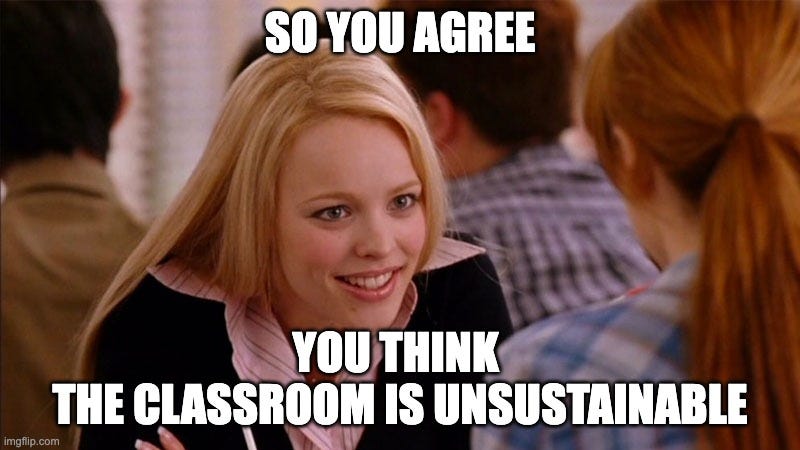
The fact that people thought I was running for president to escape the classroom is, oddly, the reason at the heart of why we ran: the classroom is unsustainable, and everyone knows. It is only a matter of time before you will want out.
I spent so much time, especially when I was put on leave, wondering if I was “ready” to leave the classroom. I’ve come to know that being “ready” isn’t a feeling, it’s simply a decision.
I had decided I was going to show our union members they had a choice in leadership. I had decided it would be time well spent to make our union more democratic, more transparent, to organize, to fight for special education and to fight for elementary educators.
The fact that Chris (for vice president, my running mate) and I were telling members we want to return to the classroom — we see term limits as imperative for leadership success, including and especially our own — was perhaps the biggest testament to who we are, why we ran, and what we are demanding from our union. It must always be working to improve the daily jobs of members. If elected and termed out, one should have a sigh of relief and think “I’m so glad this is better than when I left it”, not “Please God don’t make me go back there”.
We were comfortable saying “Hey, our jobs are getting harder every year, public schools are getting worse, there’s a different way to do this.”
And people absolutely hated us for it.
A saying from a mentor and friend
Many TOSAs have productive and effective jobs for the profession, especially in the special education department or other departmentalized buckets (such as the secondary English Department roles). Readers, especially educators, should discern between the types.