

A “boss narrative” is a story told to workers which pits them against each other rather than at the boss. They can be debunked by asking yourself a few simple questions and thinking critically about your own answers; one can then easily see they were fooled into thinking the boss had the worker’s best interest in mind.
There’s no shortage of boss narratives in any working environment, especially public education, and there’s one specifically I’d like to point out this Labor Day. It paints me as a radical and voicing it on the union presidential campaign trail would’ve brought an early nail in my coffin. Many union members would say I’m crossing into enemy territory, but hear me out:
We must organize with the charter schools if we are serious about fighting for a public education system.
Unionized public school educators, like myself, are taught to hate charter schools. We are told they are filled with unqualified and unlicensed educators, they don’t service special education students, they take our school buses, they take our funding, they take our students, and if they wanted to be A Real Teacher With A Union Contract, they could just quit their charter school and come work with us.
I’ll start with the whole “unlicensed teacher” thing.
Teaching licenses are a joke because the state makes a joke out of it.
I do not have a degree in teaching and I am a better teacher for it: I spent my college years diving deeply into literature and analysis, and the last year taking graduate courses in Literary Theory & Criticism. It was in those classes I first met hooks, Locke, Marx, Freire, and Anzaldua.
I was able to spend my higher education feeding the love and curiosity I have for literature and writing, and that is what makes me an effective teacher.
There is nothing more exciting than guiding teenagers through literary discourse and getting to see them love a character, a story, or watch their perspective deepen and world widen from a book.
There is nothing cooler than helping a 15 year old find their voice through writing, or have them unlock an emotional depth because they’ve finally found the words.
And that is not what a teaching license is. That is the freedom and beauty that education brings when you have access to it.
A teaching license is annoyingly difficult and incredibly expensive if you don’t obtain it through an undergraduate or graduate program. If you have an undergraduate degree in a specialized content area (like myself), but you complete a laundry list of education courses from an accredited university or college.
Most of mine were checked off by a masters degree I started a decade prior, but the price tag of an additional $10,000 in courses on top of being a full time teacher kick many early career educators out of the profession.
You could argue that teachers need to be specialized and have all of those additional courses completed and I would agree with you. But the debt alone is not worth it when you consider how vastly underpaid teachers are to begin with, on top of having to give 14% of our paycheck to the State Teachers Retirement System.
Couple that with the fact that you’re often too tired after work to take the courses seriously and you’re being taught by professors who haven’t been in a classroom in 20 years, and the option to continue in the profession gets less and less practical.
Enter, stage left: The charters and their attractive ability to short-circuit licensing mandates, and now, their lure to pay for the alternative licensure program itself.
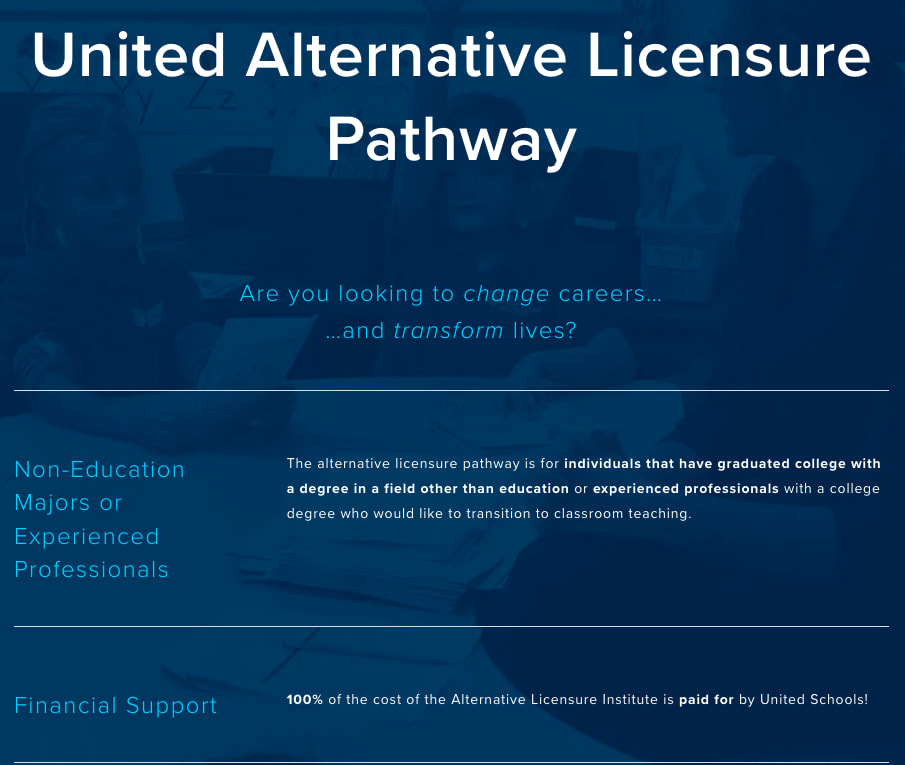
The problem, we are told, is that this allows charters to hire virtually anyone. But I have met many teachers from charter schools and they’ve always been similar to myself: holding at least one degree in a content area, passionate about teaching, but not willing to fork over the thousands of extra dollars for the slip of paper that says Great Job You’re a Teacher.
Moreover, most districts (mine included) are hurting so badly for educators there are long-term substitutes in positions that demand credentialed professionals.
For example, there are substitutes in contained special education classrooms: those special education students are not being serviced by a licensed professional.
I’ve had administrators send letters home to parents to alert them their kid didn’t have an actual science teacher teaching them content, they were simply on a computer clicking through modules and googling answers while a substitute monitored behavior.
My school is not unique in this, it is a common practice.
I love and respect substitute teachers — there is no way in a frozen hell I would ever be one — and our system cannot operate without them, but this application of those employees is a disservice to students and them. It’s also supposed to be illegal.
When it comes to special education, a talking point against charters is they can turn students away, or they don’t have to adhere to the laws regarding special education services.
But as I wrote in last week’s post, public school caseloads are so out of control that students in our system aren’t getting proper services, either.
Pot, kettle, black, and what not.
According to Ohio Revised Code, public school districts must provide transportation for students who attend charter schools within our district boundaries. If you’re reading this and you don’t live in Ohio, this creates the disaster you’re imagining.
When the school district cannot complete this task, the district has to pay for failing to transport students that aren’t theirs. The amount is the calculation of transportation cost per student and it is paid directly to the family of the impractical-to-transport student.
And yes, they do also take our funding, because charter schools are considered public schools. The unfair part is that they are also eligible to take funding from other sources, such as billionaires or groups with specific ideological agendas, because charters get to play by their own rules.
This extra funding is often what allows them to fix up buildings that public schools close and sell due to being “too expensive to upkeep”.
This is what happened with a school in my neighborhood. Built in 1912, it was Dana Elementary School in Columbus City Schools (Columbus Public, at the time) for its first 100 years.
CCS Board of Education records show it was purchased in 2014 by Columbus Collegiate Academy West for a mere $300,000:
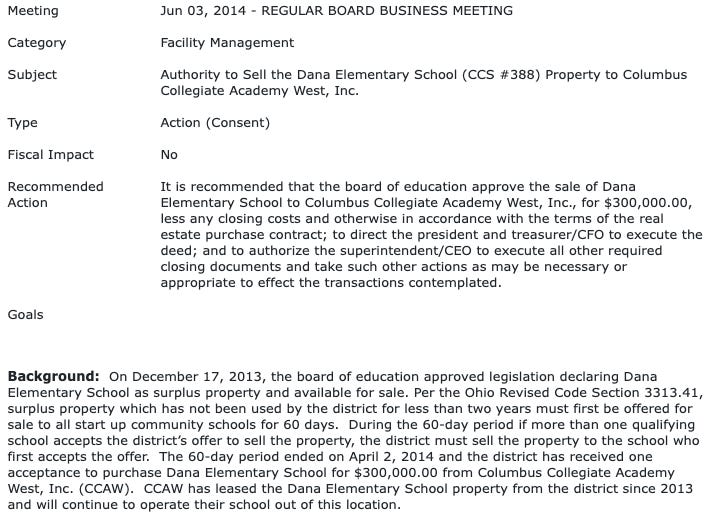
As noted in the “background” section, it is Ohio law that if a public school district closes and sells a building, they must offer it up to charter networks and private schools for 60 days and if they receive a bid, they must take it.
This past spring I was at the Ohio Statehouse sitting in on a Senate Education Committee meeting and actually met the owner of Columbus Collegiate Academy West, which has rebranded and is now United Schools, Andy Boy.
Boy was providing testimony on was SB 311, which escalates the current Ohio law in regards to who can get their hands on public school buildings first if a district deems a building inoperable.
SB 311 expands the list of eligibility from charters and community schools to include parochial schools, other private schools, Education Service Centers (ESCs, which I find to be the most alarming part of this bill, but more on that at another time), higher education operations/programs, etc.
Sitting through a Senate or House Education Committee meeting is painful because often the only people testifying are those from privatization efforts (i.e. Forham Institute, who happens to be United Schools sponsor), Christian Nationalist churches and groups, and the homeschool grifters.
Once in awhile Melissa Cropper, president of the Ohio Federation of Teachers will be up there giving testimony in person, but other than that, it’s pretty empty, all things considered.
Andy Boy got my attention when he introduced himself as the founder of the charter network United Schools because I can see their middle school from my house.
He then told the Senate Education Committee that United Schools works very closely with the public school district which United Schools operates in, in order to ensure communities are served appropriately.
I’ve known for quite some time that Columbus City Schools has a cozy relationship with charter schools, but I was interested to hear from the charter founder himself what he meant by this.
Boy exited the room after his testimony, and I followed him out. I was nervous to talk to him, but I was genuinely curious in what he had to say.
I told him it’s interesting to me that public schools and charter schools are often pitted against each other, because in my recent research, I had found that they do in fact work together more often than not.
He told me how charter schools within the CCS district had been in communication with CCS district leadership for far longer than I, or even he, had been around. He was able to list several superintendents that had worked with charter networks on many things, including school closures and the pick-up of buildings.
The more I learn about public school corruption in Ohio, including from our own employers, the more it seems that educators are the only ones in the dark about it.
I started to ask him about the United Dana middle school in my neighborhood, because I’ve actually been inside it. I had a running friend who taught there and she would often commute to work by running. Once or twice a week we would meet after school and I’d run with her to her house and then back home. It was such a convenient and fun way to get in 7 miles after school.
We would often talk about the days we had teaching, and despite me being in a unionized public school district and her being in a charter, we pretty much had the same working conditions, including wins and complaints. One time she had forgotten something inside and I went back with her and got a quick tour of part of the building.
Our friendship is what started to make me realize the weakness of our unions and the false narrative of public vs. charter. We sometimes talked about it and she would challenge me on some of my talking points (rightfully so, I’d learn), but mostly we talked about running, relationships, and being women in our 30s.
I told Andy Boy the school building which now houses United is absolutely gorgeous inside, and I was sad that CCS had actually let it go. He told me it took a lot of money to get it back up and running to an operable condition for students and staff, no less than $3,000,000.
He also told me that when United takes over an empty school building, the neighborhood has more children, and families are more engaged in the community.
I have no idea if his assessment of neighborhood activity is true or not, especially because his company has been operating that building for the entire time I’ve lived here, but it would makes sense.
I also find myself thinking about the $3,000,000 price tag of updating the building. It seems like a lot of money, but all things considered, it’s not.
The problem is I’d be willing to bet the vast majority of CCS buildings need at least $3,000,000 of updates, and charter school networks are generally just a tax dumping ground for the rich who then have access to an incredibly amount of information about children (side-eyeing KIPP here, who has Abigail Wexner — wife of Leslie Wexner, widely known as Jeffrey Epstein’s #1 unindicted co-conspirator — in a prominent Board position) and a fast-track to further privatizing education.
We will not be able to beat the charter school system and it is a waste of time to keep peddling the idea that we could. The only way forward is to band together and organize with the charter schools.
If you’re experiencing a visceral reaction to that idea, take some time to dismantle it and think about where that comes from.
It probably comes from your union, telling you that charter schools are our enemy: they’re undeserving, they’re not real educators, they work for the people convincing our legislators to destroy public education by funding them and not us.
News flash: The people working in charter schools are real educators. They love teaching, just like we do. They are also workers, and all workers deserve the right to organize with and for collective action.
The students in those buildings are also children, just like our students. They deserve access to an equitable, safe, and appropriate education, just like our students do.
When we organized for a union at my last job, we wanted a say in our workplace, and a massive part of that was because we were doing the work. We knew how to do it best, how we wanted to improve, and we believed we deserved access to the tools to improve.
The professional development talking point of teacher unions is the most boring, and in my union, we have almost zero control or influence over the professional development that we receive.
We almost had it in CCS in the Secondary English Language Arts department, but then the district RIF’ed all those union positions, just as we were starting to get somewhere (this is by design).
If we truly care about elevating our profession and serving our students, which I believe all educators do, we must start to operate as one and disavow the division. Charter school educators work directly for the billionaires, and public school educators work for the government.
The government is owned by the billionaires. We all have the same boss, you don’t have to look hard to see it.
They treat us as if we are the same, so let’s start acting like it.
We cannot wait any longer.
*Two charter schools in Ohio are unionized: KIPP Columbus and Menlo Park Academy. Both are under the state affiliate of the Ohio Federation of Teachers.