

When I started writing about the Columbus City Schools (CCS) Insurance Crisis Swindle, someone I have never met before stitched my video on TikTok and warned the public I was about to be retaliated against, and it was likely going to be bad.
As of the posting of this article, retaliation from my employer has started and it has been documented. I am not experiencing retaliation from my building administrators, and I have not yet been disciplined for whistleblowing on my working conditions and the use of my property tax dollars.
If you’re a recent subscriber, I call your attention to the first post of Shotgun Chelsea, which, at the time, was the latest and most egregious act of retaliation from my employer.
Last week’s post highlighted an important piece of the high school matriculation plan, — now being used as the north star for CCS’s latest warpath on educators — which is the sham of the Apex track for high school students who are failing their classes.
This week’s post brings up another important piece of the high school matriculation plan, which is when CCS high schools openly push their students out of their buildings and into charter schools.
What happened at Marion-Franklin
In a public records request recently shared with Shotgun Chelsea, Marion-Franklin High School Principal Tanita Fleming demonstrates an effort that was reportedly replicated at varying measures at many high schools across the district.
It is important to note Marion-Franklin High School is on the list for closures and consolidations in Columbus City Schools. The district cites under-enrollment for a reason to consolidate schools, but no one has mentioned the under-enrollment is at least partly, if not fully, caused by leadership.
The public records request contains the following documents showing Principal Fleming at Marion-Franklin High School routinely invited the charter school Early College Academy (ECA), into their building to recruit students during the 2025-2026 school year.
As early as four weeks into the school year, Principal Fleming sent the following email to a group of employees she addressed as the “Senior Matriculation Team”(redactions mine):
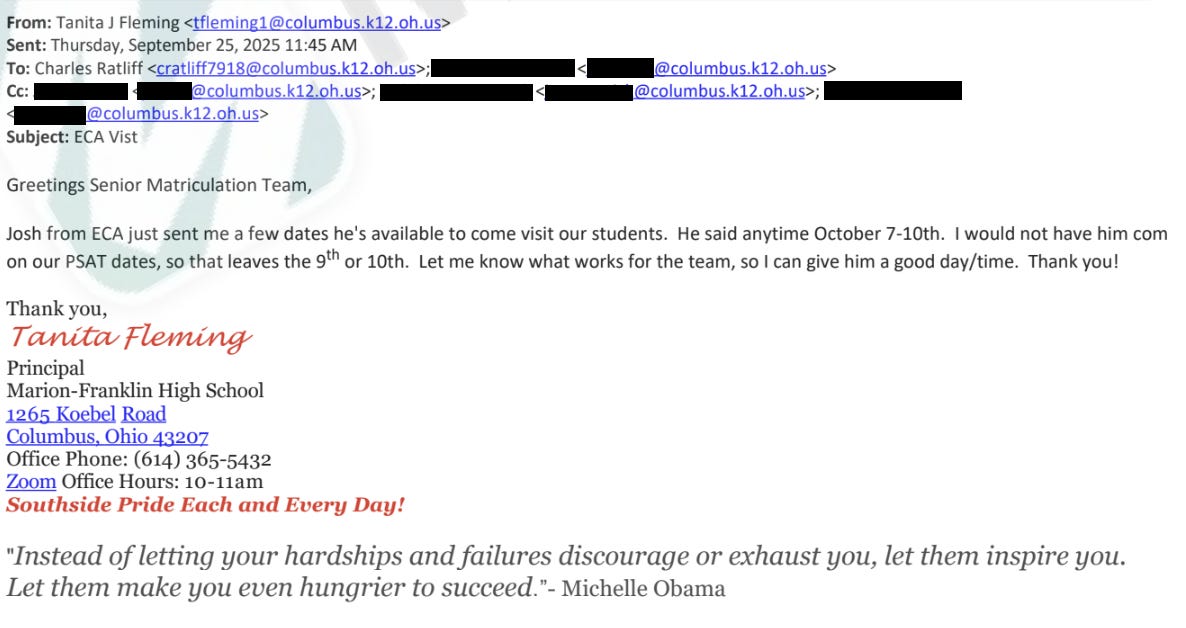
Public records show a meeting date was set for Friday, October 10th, and the conference room was reserved. The “Josh” Fleming referenced is listed on ECA’s website as the “Dean of Students/Principal”.
While the specific qualifications for students who are recruited out to charter schools are not known, students are apparently identified by adults in the building, as demonstrated by this email Principal Fleming sent later that day (email address redactions mine):
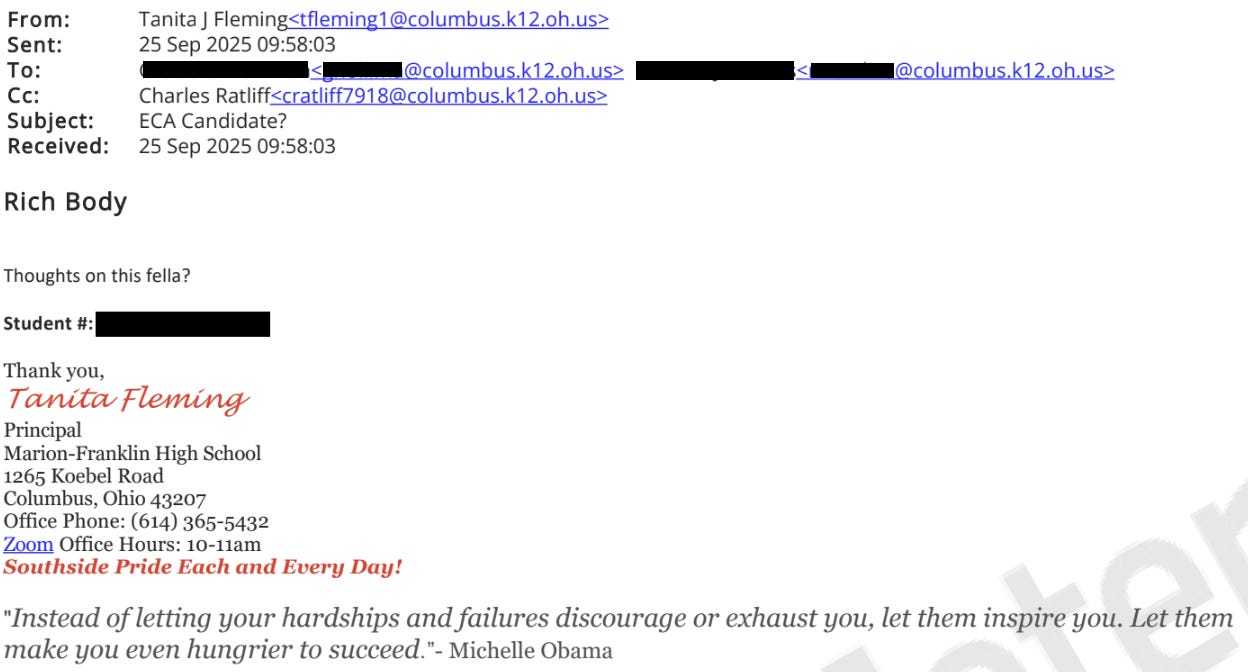
ECA’s website states it started as “Academic Acceleration Academy” and was sponsored by Columbus City Schools as its first charter school. That was (obviously) long before my time, but the website goes on to state it is now, very clearly, an independent charter school.
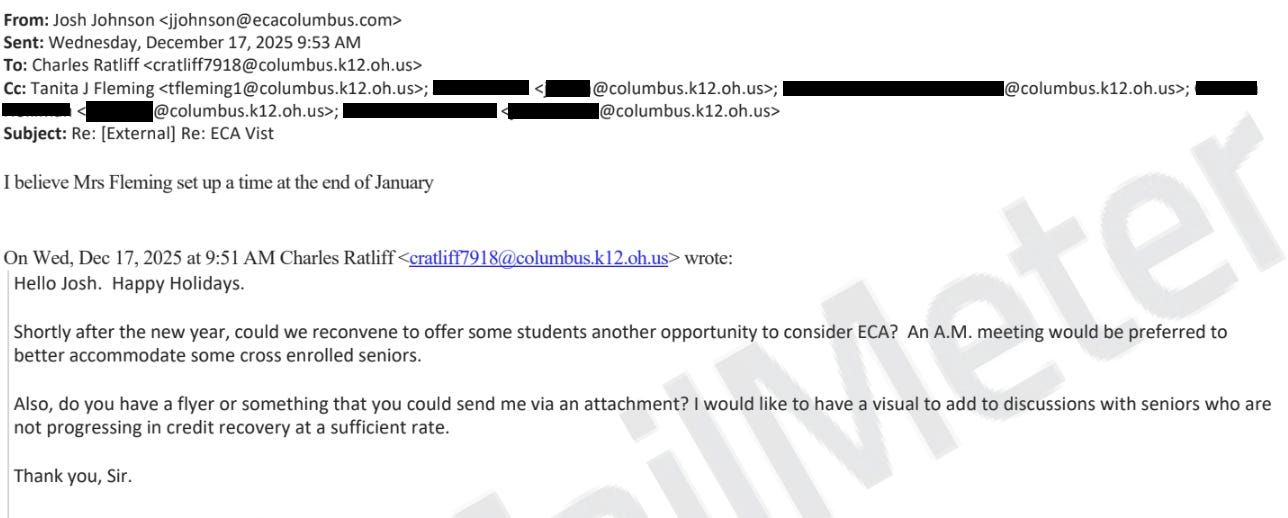
As soon as December 17th, Assistant Principal Ratliff reached out set a time after the new year to offer Marion-Franklin students “another opportunity to consider ECA.” This time, the meeting was set at a time to ensure “dual enrolled” students could attend.
When a student is dual enrolled, it means they attend their ‘home school’ in CCS for half of the day for their core academic classes (science, English, math, and social studies), and the other half of their day at the Fort Hayes Career Center.
It turns out there was actually already a meeting to recruit more students to the charter school on the calendar; Principal Fleming had set one up with Josh for the end of January (redactions mine).
Not only is the district recruiting away from their neighborhood school, but also their speciality programming options. Fort Hayes Career Center is a highly desirable opportunity and the only entry point is through a ‘lottery’ program that students enter after they visit the campus.
Watching students go through that lottery process was a heartbreak I didn’t see coming.
Students visit the Fort Hayes Career Center when they’re in 10th grade. I taught sophomores for three years. One year I went on the field trip as a chaperone, and it was an absolute blast.
As an employee, it was amazing to see fellow educators in their work environments; as a teacher, it was so fun to be alongside my students watching them explore their potential interests outside of our classroom.
This process is then replicated with CCS’s Downtown High School, which houses programs such as culinary, education, public safety services, and cosmetology.
When we returned to our building I helped students fill out the application and choose their top three choices of programs. They’d discuss different opportunities and dreams they have for themselves and for each other; some students have no interest in applying to Fort Hayes CC or Downtown HS, but the majority do.
A few weeks later, I would watch those dreams crash as the majority of students are rejected from the programs.
I do my best to pick up the pieces and show them mosaic art is full of hope and beauty, as our dreams shattering can lead to something more beautiful if we’re willing to see it, or willing to make a new vision and reassemble the pieces.
Students, educators, and communities deserve a school system that is focused on serving kids and investing in programs that have proved valuable, yet CCS continues to kneecap programs that work.
Marion-Franklin’s intention to include Fort Hayes CC students in their charter school recruitment is only one example of this.
Parents and educators from both the CCS Preparatory School for Boys and CCS Preparatory School for Girls filled the room the last board meeting, urging board members to understand it’s not the buildings or programs that are under-enrolled, it’s the district is capping it’s own enrollment and refusal to promote said programs.
Word of mouth in the district says the programs at Downtown High School will close after this year, with the exception of the culinary and cosmetology programs. No formal word has come of this yet, but the decision to move the Columbus Alternative High School into the Downtown High School building would support the rumored programming closures and consolidations.
It would seem the district, under its current leadership, is creating its own under-enrollment problems in order to justify closure.
Shotgun Chelsea has an anonymous tip line set up to report behavior referrals and write-ups for public education bad actors.
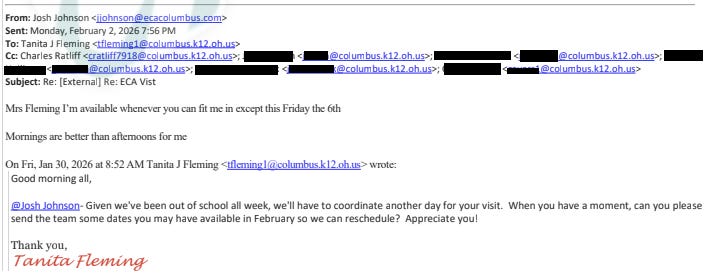
The meeting that Principal Fleming set up for the end of January had to be rescheduled; as it would turn out, we’d have a full week of snow days and extreme cold.
Principal Fleming emailed the ECA Dean of Students/Principal on January 30th to reschedule for a date in February (redactions mine).
When a meeting date for February was in the works, Fleming then gave a directive to Assistant Principal Ratliff to discuss the matter “during your matriculation meeting tomorrow,” and specifically notes the upcoming ECA meeting will be to recruit juniors to attend the charter school.
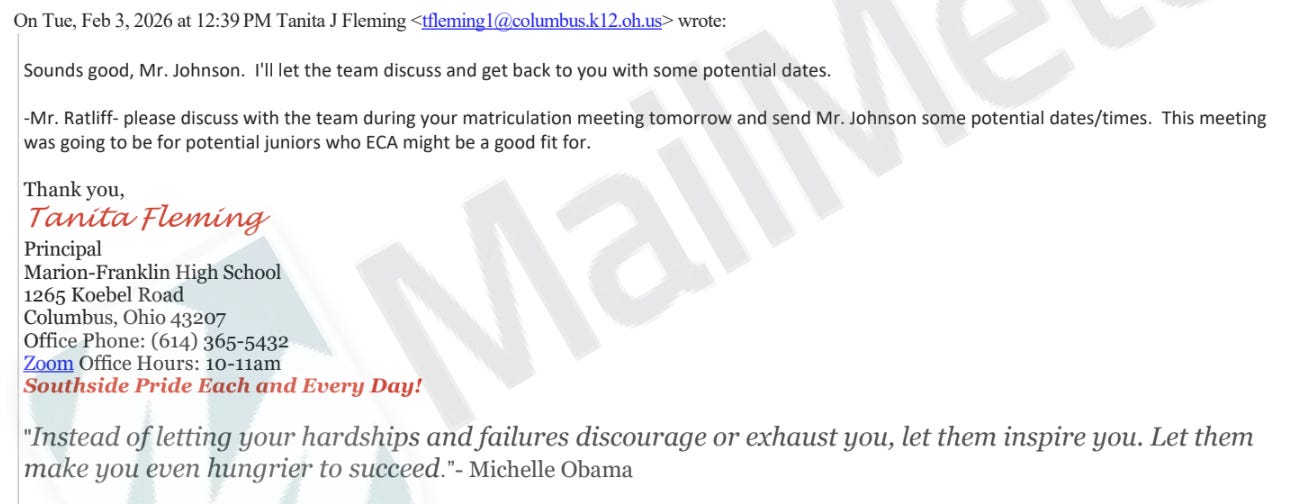
Charter school recruitment was being done under CCS “matriculation” programming. The “matriculation” that has brought such “success” to the district, it is now the inspiration for middle school math.
This charter school practice could very well happen at the middle school level, too, but I don’t work in middle schools and am not privy to how they deal with the plights of educating pre-teens, and I have seen no records of it.
When principal-driven charter recruitment happened a few years back at my high school (under our previous building administration, not our current building administration), it was brought to my attention by special education teachers, because the students being recruited out were, at an alarmingly high rate, kids with an Individualized Education Plan (IEP).
ECA was not the specific charter students were being pushed out to from my school, it was actually Focus Learning Academy — an online charter school with multiple sites in the city.
When I went to our union leadership about this, we were told to report our boss’s activity to the internal auditor through a form found on the website.
Multiple staff members did, and it is my understanding our building administration stopped the practice. While that is a ‘win’, the problem has apparently persisted throughout the district for years, with no known repercussions, which is the trend I see with every problem.
At the start of this school year, I was informed by multiple building administrators outside of my worksite, and from different schools, principals across the district had been told to stop the practice.
I witnessed reactions to this directive from both ends of the spectrum: one extreme with “Can you believe people do that?!” to the other, with a lowered tone, “Someone is catching on.”
I would’ve let sleeping dogs lie, but closing and consolidating Marion-Franklin without the public knowing how enrollment is manipulated by the district itself should be unacceptable.
Taxpayers deserve more transparency, and educators deserve to know how the system operates and how we are being used in it. I’m not saying CCS shouldn’t close any schools, but to claim low enrollment when you’re showing students the door is not being truthful about the state of the district.
Know something? Say something.
On Wednesday, February 18th, Assistant Principal Ratliff sent an email to the ECA employee asking if he could come visit the upcoming Monday, “as early as 8:00,” and the ECA employee agreed.
According to the email below, Marion-Franklin’s Senior Matriculation Team met the next day, February 19th, and after that meeting, Assistant Principal Ratliff asked to reschedule for a later date in order to better communicate the opportunity to parents.
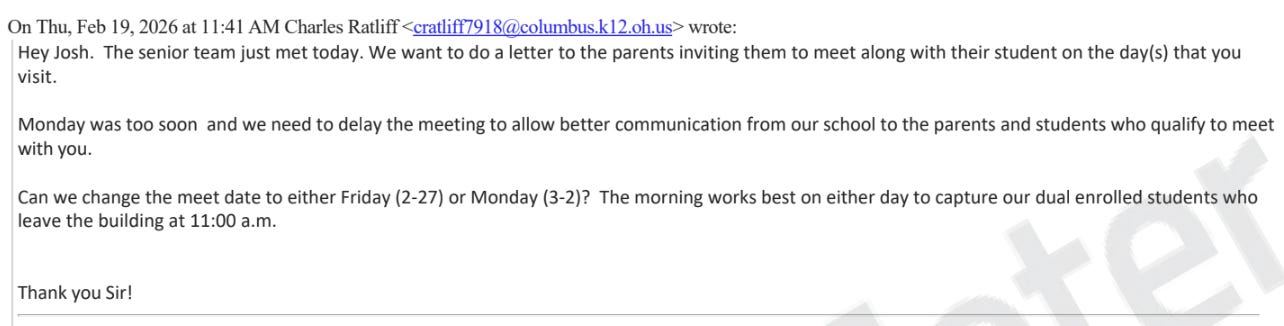
If I wasn’t so appalled by the behavior, I’d find this consideration of parents refreshing. Parents should not only be consulted regarding their child’s education, but rather treated as a true partner in their child’s education.
I am not a parent, but when I think about this situation from a parent perspective, they are likely to be convinced to move their child to a charter school if their public school administrators are scheduling a meeting with them to discuss the student’s matriculation and ‘other options’.
It signals to the parent the public school is incapable of serving their child, even if no one says it outright.
…And the public school system does appear to be failing their child, but it’s by design and often because of choices made by district leadership. CCS has had different education opportunities for students, but they have been eliminated willingly by the district administrators and school board majorities.
This can be seen as recently as the 2023-2024 school year, when CCS closed its K-6 portion of the Columbus Online Academy. This decision resulted in more families choosing charter schools that offer an online option.
The conversation is always “Which schools can we close?” and never “This is our plan to recruit students.”
When school teams make lists of students “who qualify” for charter school recruitment, I do not believe they would have ‘special education’ as an identifying factor, but it would not be surprising if there was a correlation, as there was at my school when this happened a few years ago.
Our special education teachers are far past their capacity with their workload, because the majority are far over their legal caseload. When that happens, it is unrealistic to expect students are receiving the services they need. The legal caseload exists for a reason.
When students’ needs aren’t being met, the probability of them failing academics skyrockets. This is understandably and often (not always) reflected in their behavior.
Though not necessarily the fault of the student, the student bears the consequence. Those consequences can include being pushed out of your school.
ECA is not only in Marion-Franklin, but also on a School Board Committee
To thicken the crosshairs of this dynamic, an ECA employee currently serves on a CCS Board of Education Committee.
Retired CCS teacher, and current charter school Early College Academy teacher Cynthia Price is serving on the CCS Equitable and Transparent Resource Management (ETRM) Committee, chaired by Board Member Patrick Katzenmeyer.
As I explained in a prior post, the ETRM Committee and Academic Facilities Alignment Committee (AFAC), chaired by Board Member Jen Adair, are now operating as a “joint committee” in light of the impending announcement of school closures amid the anticipated updated school closure policy.
Why is a charter school employee serving on our school board committee?
The district is holding an event tonight, Monday November 2nd, at Marion Franklin. It is being advertised as a “family listening session” with the district’s superintendent.

How both parties benefit and the student loses
CCS administrators have an interest in getting students who are not academically succeeding out of their building because it will increase their graduation rate, and our district and state have put a lot of pressure on that number increasing.
In Ohio, public high schools have what is called a “denominator”, which is the number of students the school is accountable for in its graduation rate. When a student is enrolled in a public high school, they are part of the denominator, no matter at which point in their high school career they enroll. Students have 4 years to get through high school and graduate, and the timer starts when they enroll in high school (traditionally as a freshman).
The graduation rate for the high school, which is part of the state report card, is based off of the denominator number, which can be different from the actual number enrolled in the school, here’s how:
When a student leaves high school A and enrolls in high school B, high school B requests the student’s records from high school A. Once those records are requested and sent, the student is officially out of high school A, and no longer part of the denominator number.
If the student leaves high school A and high school A never gets a request from another high school for the student’s records, the student is still part of the denominator number, and will count against high school A in their graduation rate.
The student could start freshman year at high school A and attend for the first week, and never again, and student A would still be part of the denominator number and graduation rate calculation.
Keep in mind the student has state money attached to them.
When the student attends high school A, school district A receives the allocated state funds for the student. When the student attends high school B, school district B receives the funds for the student.
Now let’s consider the scenario where high school B is a charter school. The charter school, and not the school district, is now receiving the state money for the student, in addition to other funding sources (often from the billionaire elite class, of which said monies are often tax write-offs and contributing to increasing wealth for that class).
Charter schools also have less concern around graduation rates. This does not mean people who work at charter schools do not care about whether students gradate or not, it simply means charter schools are not held to the same operational standards, because
They can take as many funds from outside sources as they wish (whereas public schools cannot) and
They still receive funding from the state, sometimes extra funding, even if they’re deemed ‘low performing’. Stephen Dyer does excellent reporting on this issue.
So if high school A has a low-performing academic student who likely won’t graduate in 4 years, and has locked in and sourced a charter high school B to take the student and their records, it is considered a ‘win’ for both schools, because high school A’s denominator improves, and high school B profits.
It really, truly, is all about money.
And the student, predictably, usually loses. Dyer points that out in article after article, but particularly well when explaining how Ohio charter school students spend far longer in poverty than Public School graduates.
Charter schools have every incentive to recruit student after student because it is profit after profit, especially because public dollars are allocated for enrollment until the age of 22.
If a charter school is underperforming and forced to close, they can simply close under one name and reopen under another. The clock restarts for their performance metrics, and they continue to rake in the cash.