

This past week members of the Columbus Education Association (CEA) found out what $40,000,000 looks like when it comes out of their paychecks.
Despite the Columbus City Schools district administration being at fault for losing $40,000,000 by mismanaging the employee health insurance program, Dr. Angela Chapman and her cabinet are pushing 100% of the loss on to the backs of the workers.
To help readers understand what public school workers are enduring, here is a simple table that shows the amounts being taken out per paycheck for employees.

You’ll notice options are denoted as “grandfathered”, which is the direct result of a successful union busting tactic that the district executed and the union fell for in 2009. Creating tiered systems among union members is one of — if not the — most classic boss moves in negotiations.
Back in 2009, the district was in financial crisis (as it apparently always is) and made an offer to the union they could not did not refuse: take a pay freeze, but have a guaranteed low cost of healthcare for the duration of employment; everyone hired after this negotiation will have a different, much higher rate.
Grandfathered employees argue that they’ve incurred years of lost wages for taking the freeze in steps on the pay scale, and everyone hired after 2009 sees it as paying hundreds of dollars more per paycheck and thousands of dollars more per year than their colleague for the exact same healthcare plan.
Unfortunately, both groups are correct.
When unions are not militantly organized, succumbing to playbook tactics from the boss is inevitable. The damage is not only done to the wallet of the employee, but to the union as a whole, as this creates a division in the workers that is near impossible to overcome.
With the current situation, though, the hardest financial hit undoubtedly goes to the workers making the least amount of money. If you were hired after 2009, have a family, and are the insurance carrier for said family, you are paying $678—$711 for health insurance every two weeks.
And the Columbus Board of Education could not care less.
The district’s employee health insurance is self-funded, which means we only pay for what we use. Unlike car insurance where you pay a certain amount up front every month in hopes that you don’t have to use it, we only pay for the claims we have made.
…And we have a lot of claims.
It’s not the fault of the workers, it is the fault of the billionaires running the scam of health insurance on the American people. Cancer treatments do not need to cost $1,000,000. Your infant’s care in the NICU having a price tag of $1,000,000 is criminal.
This is well understood in our society, which is why the internet erupted with cheers when Luigi pulled the trigger on that fateful day in December 2024.
The district agreed to our insurance plan, and when we started using it, no one was keeping an eye on the bank account that pays for our claims. In fact, in the district investigation report, it says our HR department was under the impression it was flush with cash, to the tune of $400,000,000.
Well, it wasn’t.
CCS is now tacking “surcharges” onto its employees to make up the difference for their negligence. The district and the union are at odds with who is correct in this situation.
The district is arguing the contractual agreement between the union and the district is clear: any health insurance program increases which are 8% and under are split equally between the employee and the employer. Any increases over 8% fall solely on the employee (yes — that is actually negotiated language in our contract).
The union is arguing the district withheld information about the state of the health insurance program and therefore was not a good faith participant in the Joint Insurance Committee, which should essentially nullify the contractual language saying the increase should fall only on the employees.
Contract language aside, what Columbus City Schools is doing to its employees feels, and should be, punishable by law. It has many employees asking what our legal options are to fight this, and where is the legal muscle that our dues dollars so diligently fund?
That question was answered this past Thursday night when members from the legal team of the Ohio Education Association (OEA — the state affiliate of the CEA) took the virtual stage on a mass general membership union meeting.
They not only told members there was nothing they, as lawyers from OEA, could do; they also told Columbus members what they could not do: they are not legally allowed to withhold their labor in protest against this massive abuse of power being executed upon them by their employer.
This is due to an article in the educators union contract, known as the Continuous Performance Pledge. It says a work stoppage will not occur within the duration of the contract, meaning, only when the contract is expired and the union is in negotiations are members able to strike.
It’s not really an all-or-nothing situation, though. The fund needs to be replenished, and it does not and should not need to fall on the backs of the workers. The district should be audited and monies should be allocated to the fund immediately, the balance reassessed, and the fund further replenished by the district by as large of a percentage as fiscally possible.
This assessment of financials needs to be presented publicly to the Board of Education by the Treasurer, with an actuary consulted and present for questions.
After that, should employees need to increase their input into the fund, it should be done over the course of at least 24 months, not 12. The district is trying to cram the surcharges into one year, and their argument for that has never been presented.
Perhaps that’s because no one has asked the district a goddamn question about it besides the teacher’s union — including the Board of Education.
In fact, just this week, CCS Board Member Patrick Katzenmeyer posted the following on his Instagram story:
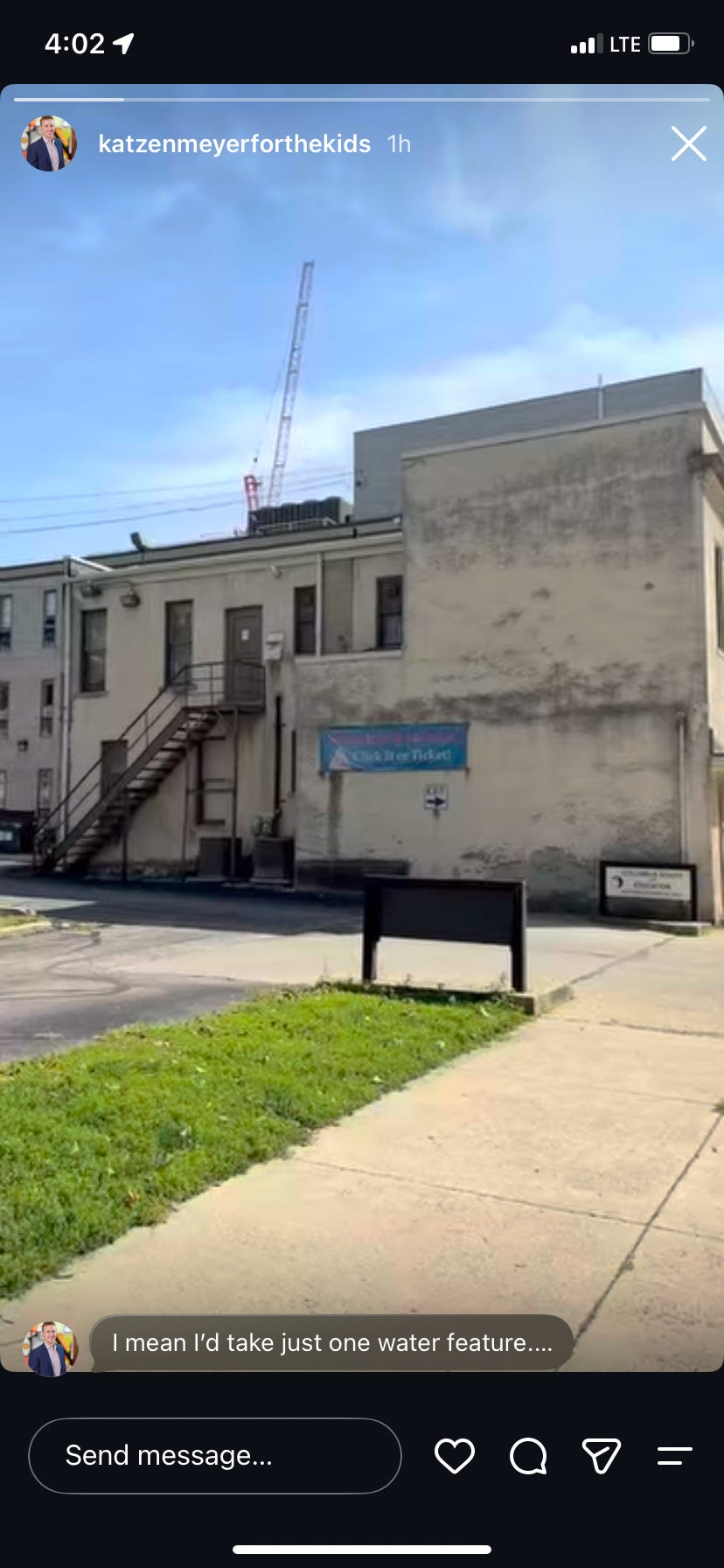
In case you aren’t painfully aware of the CCS administration buildings, this is 270 E. State Street, downtown Columbus.
The CCS staff is lying awake at night worried about how they’re going to make ends meet, updating their resumes, and looking into predatory money loaning companies to pay for their health insurance just so they can keep working.
Our board member is concerned about the lack of water features at a district administration building downtown. I highly doubt this publication makes it to the eyes of people in power, but on the off chance it does make it to a screen being gazed upon by Katzenmeyer: I’m sorry, but I had to. I believed in you as a board member, and you can win me back by supporting the workers that endorsed you.
I’m told the health insurance was once a major draw to employment in Columbus City Schools. With that gone, on top of the crumbling buildings, the unchecked administration, horrific list of grievances, illegality of the special education department, and the continuation of the closing of schools, I’m truly wondering why anyone would want to work in Columbus City Schools.
If you cannot retain your educators — especially your early career educators — and you have no incoming educators, you will have no school system. I speak not in hyperbole but practically: we will not have employees; the ones that do stay will be pushed out by the working conditions that are to come as a result of the exodus that will occur.
We are told we must pay for their mistakes.
We are told we cannot strike.
But there is an old labor saying, it hollers from the mine shafts in our very own Ohio, pulsing deep in the Appalachian range where the donned red bandanas crooned which side are you on: there is no such thing as an illegal strike, just an unsuccessful one.